
.png)


Your First-Timer's Guide to Thai Culture at Southampton Thai Festival 2026

You Don't Need to Know Anything — But Knowing a Little Changes Everything
If Southampton Thai Festival 2026 is your first encounter with Thai culture, you are in exactly the right place. The festival at Hoglands Park on 4 and 5 July is designed to be welcoming, accessible, and genuinely fun for newcomers. But like any cultural experience, it rewards those who arrive with a little background knowledge. Understanding what you are seeing — why the dancers move the way they do, what Muay Thai actually is, what makes Thai food distinctive from other Asian cuisines — transforms the day from enjoyable to genuinely memorable.
This guide is written specifically for first-timers. No prior knowledge required.
Understanding Classical Thai Dance

What You Will See
On the main stage at Hoglands Park, classical Thai dancers appear in some of the most elaborate costumes in any living performance tradition. The outfits — layered silk in deep reds, golds, and blues, finished with towering gilded headdresses — are not merely decorative. Every element carries symbolic and ritual significance rooted in centuries of Thai royal court culture.
Why the Movements Look the Way They Do
Classical Thai dance is called Khon (โขน) or Fawn Thai depending on the tradition and region. What distinguishes it from Western dance forms immediately is the extreme precision and deliberate slowness of the movements. Fingers are bent back almost perpendicular to the wrist. Footwork is exact to within centimetres. Every position of the hand, angle of the head, and placement of the feet carries specific meaning — telling stories from the Ramakien, Thailand's national epic poem derived from the Indian Ramayana.
This is not improvisation. Dancers train for years to master the vocabulary of movements, many of which are performed in slow motion to allow the audience to appreciate the technical precision involved. When you watch a classical Thai dancer at the Southampton festival, you are watching the result of an extraordinary amount of disciplined practice — and a tradition that has been performed continuously for over four centuries.
What to Watch For
Pay attention to the hands above all else. The hand positions — called mudras — are essentially a sign language, each one encoding a specific word, emotion, or narrative moment from the story being told. Watch also for the quality of stillness between movements: in classical Thai dance, the pauses carry as much meaning as the motion.
Understanding Muay Thai

What It Actually Is
Muay Thai — วิชาชกมวยไทย — is Thailand's national martial art and one of the most technically sophisticated striking systems in the world. Often described as the "Art of Eight Limbs," it uses fists, elbows, knees, and shins as weapons, giving practitioners eight points of contact compared to the four used in Western boxing. It is the foundation from which much of modern mixed martial arts striking technique is derived.
Its Cultural Significance
Muay Thai is not simply a combat sport. It is a cultural institution in Thailand, with deep roots in spiritual practice, ritual, and national identity. Fighters traditionally perform the Wai Kru Ram Muay before a bout — a ritual dance of respect dedicated to their trainer, their family, and their nation. This ceremony, which involves slow, meditative movements around the ring, is one of the most moving elements of any Muay Thai event and is likely to be included in the demonstration at Southampton.
What You Will See at the Festival
The festival's Muay Thai demonstration showcases the art's techniques through both exhibition bouts and skills displays. For first-timers, the most striking aspects are typically the use of the elbow — far more powerful than most people expect — and the knee strikes in the clinch, which are a defining feature of Muay Thai unavailable in most other combat sports. The demonstrations are exciting, technically impressive, and genuinely informative about a tradition that is central to Thai national culture.
Understanding Thai Food: More Than Pad Thai
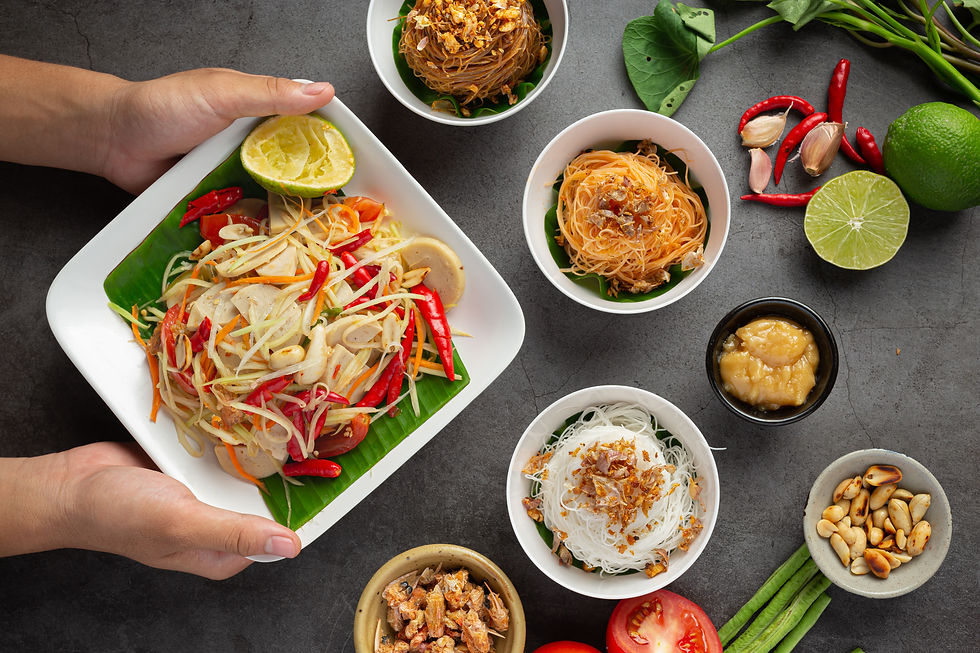
The Five Flavour Principles
Thai cooking is built around the principle of balance across five taste profiles: sweet, sour, salty, spicy, and bitter. A well-made Thai dish holds all five in simultaneous harmony rather than allowing any single note to dominate. This is why Thai food is often described as "complex" — it is not that any individual ingredient is complicated, but that the combination creates something far more nuanced than the sum of its parts.
The Regional Diversity Most People Don't Know About
What is served as "Thai food" in UK restaurants is typically Central Thai cuisine — the Bangkok-influenced tradition of pad thai, green curry, and tom yum. But Thailand has four distinct regional food cultures, each with its own ingredients, techniques, and flavour profiles.
Northern Thai cuisine, from Chiang Mai and the surrounding mountains, is earthier and less sweet — featuring dishes like khao soi, a rich coconut curry noodle soup. Northeastern Isaan cuisine, from the plateau bordering Laos, is intensely flavoured and fermented — the source of the grilled sausages and som tam papaya salad you will find at the festival. Southern Thai cuisine, from the peninsula near Malaysia, is coconut-heavy, intensely spiced, and influenced by Malay cooking traditions.
At Southampton Thai Festival, you will encounter dishes from several of these traditions — a genuine introduction to the breadth of Thai culinary culture.
How to Eat Adventurously Without Getting Overwhelmed
Start with something familiar — pad thai or spring rolls — to establish a baseline. Then try one dish that is genuinely new to you: perhaps Isaan-style fermented sausages, or a cup of authentic Thai iced tea made with condensed milk and Thai tea leaves. The vendors at the festival are invariably enthusiastic about their food and happy to explain what they are serving. Asking questions is one of the best ways to make the experience more meaningful.
Traditional Thai Massage: A 2,500-Year Tradition

One of the most distinctive offerings at Southampton Thai Festival 2026 is traditional Thai massage — and it is worth seeking out, particularly in the afternoon when the day's walking starts to make itself felt.
Traditional Thai massage, known as Nuad Boran (นวดแผนโบราณ), is a therapeutic practice approximately 2,500 years old, originating in the same Ayurvedic and yogic traditions as Indian medicine. It is fundamentally different from the massage traditions most Western visitors are familiar with — it involves no oils, is performed fully clothed, and focuses on stretching and pressure along the body's energy lines (called Sen lines) rather than muscle manipulation.
A session typically feels like a combination of deep stretching, acupressure, and assisted yoga. The effect — particularly on tired legs and a back stiffened by hours of standing — is remarkable. It is one of those experiences that first-timers often describe as unexpectedly transformative, and it provides a genuine insight into a branch of Thai traditional medicine that has been practised without interruption for millennia.
The Deeper Meaning of Thai Festival Culture
Sanuk: The Thai Philosophy of Enjoyment
Thai culture has a concept called Sanuk (สนุก) — roughly translatable as "fun" but carrying a deeper meaning: the idea that all worthwhile activities should contain an element of joy and playfulness. In Thailand, Sanuk is not optional; it is a fundamental cultural value. Work, social interaction, and even ritual are approached with the expectation that they should be enjoyable.
You will feel this at Southampton Thai Festival. The vendors are enthusiastic and warm. The performers radiate genuine pleasure in what they are doing. The atmosphere is generous and welcoming. This is not accidental — it is a cultural value being expressed through the medium of a public celebration.
Community as Celebration
Thai festivals are rooted in the tradition of community gathering — the idea that cultural identity is maintained and transmitted through shared public experience. For the Thai community in Hampshire and the wider South of England, Southampton Thai Festival is an annual affirmation of identity, heritage, and belonging. For visitors from outside that community, attending is an act of cultural curiosity and respect that the festival organisers take seriously.
Approaching the day with genuine interest rather than as a passive consumer — asking vendors about their dishes, watching the dance performances attentively, learning one Thai phrase — makes the experience richer for everyone involved.
Simple Thai Phrases to Know Before You Go

Knowing even a handful of Thai words makes an immediate and genuinely appreciated impression on Thai vendors and performers. Here are five phrases worth practising before 4 July.
Sawasdee (สวัสดี) — Hello / Goodbye. The universal Thai greeting, accompanied by a slight bow with hands pressed together in a prayer position (the Wai).
Khob khun (ขอบคุณ) — Thank you. Add "krap" if you are male (khob khun krap) or "ka" if female (khob khun ka) for added politeness.
Aroy mak (อร่อยมาก) — Very delicious. Quite possibly the most useful phrase at a food festival. Vendors will be delighted.
Phet nit noi (เผ็ดนิดหน่อย) — A little bit spicy. Useful for calibrating your order.
Sabai dee mai (สบายดีไหม) — How are you? A warm conversational opener that will be met with a smile.
Fortune Telling: Old Tradition, New Experience
The festival's fortune-telling booth sits at the intersection of entertainment and genuine Thai spiritual tradition. Fortune telling — through various methods including tarot-style cards, palm reading, and numerology — has deep roots in Thai culture, where it intersects with Buddhism, animism, and the broader Southeast Asian tradition of seeking guidance from spiritual practitioners.
Approaching a fortune-telling session with an open and playful spirit, as Sanuk encourages, is the recommended approach. Whether you leave with a meaningful insight or simply a good story, it is one of those distinctly festival experiences that adds texture to the day.
Your Essential First-Timer Checklist
Before you leave for Hoglands Park on 4 or 5 July, run through this list.
Tickets booked in advance via TicketSource at southamptonthaifestival.com — adult £6.00, child (5–15) £3.00, OAP £4.50, family £15.00, under-5s free.
Cash in your wallet alongside your card — most stalls prefer it.
Sunscreen, hat, comfortable shoes, and a light waterproof layer packed.
One Thai phrase memorised — "aroy mak" will serve you particularly well.
Arrival planned for 10:00–11:30AM for the quietest, most relaxed start.
Afternoon time set aside for traditional Thai massage.
A genuine sense of curiosity and openness — the rest takes care of itself.
Come and Discover Thailand in Southampton
Southampton Thai Festival 2026 takes place on Saturday 4 and Sunday 5 July at Hoglands Park, Southampton, SO14 1JZ, from 10:00AM to 7:00PM. Tickets are available at southamptonthaifestival.com.
For any questions, contact Joon at thaifestival.soton@gmail.com or 07936 992 995.
Follow the festival on Facebook and Instagram at @SouthamptonTF and @SouthamptonThaiFestival for updates, performer announcements, and behind-the-scenes content as July approaches.


Comments